
 Share this
Crude Oil Prices Spike as Strait of Hormuz Faces Closure
Crude oil prices surged sharply as markets opened on March 2, 2026, following the coordinated US-Israeli military strikes on Iran that began on February 28. Brent crude, the global benchmark, briefly touched $82.37 a barrel on March 1, its highest level since January 2025, before settling around $77-$79. West Texas Intermediate climbed over 8% to roughly $72, up from $67 on Friday.
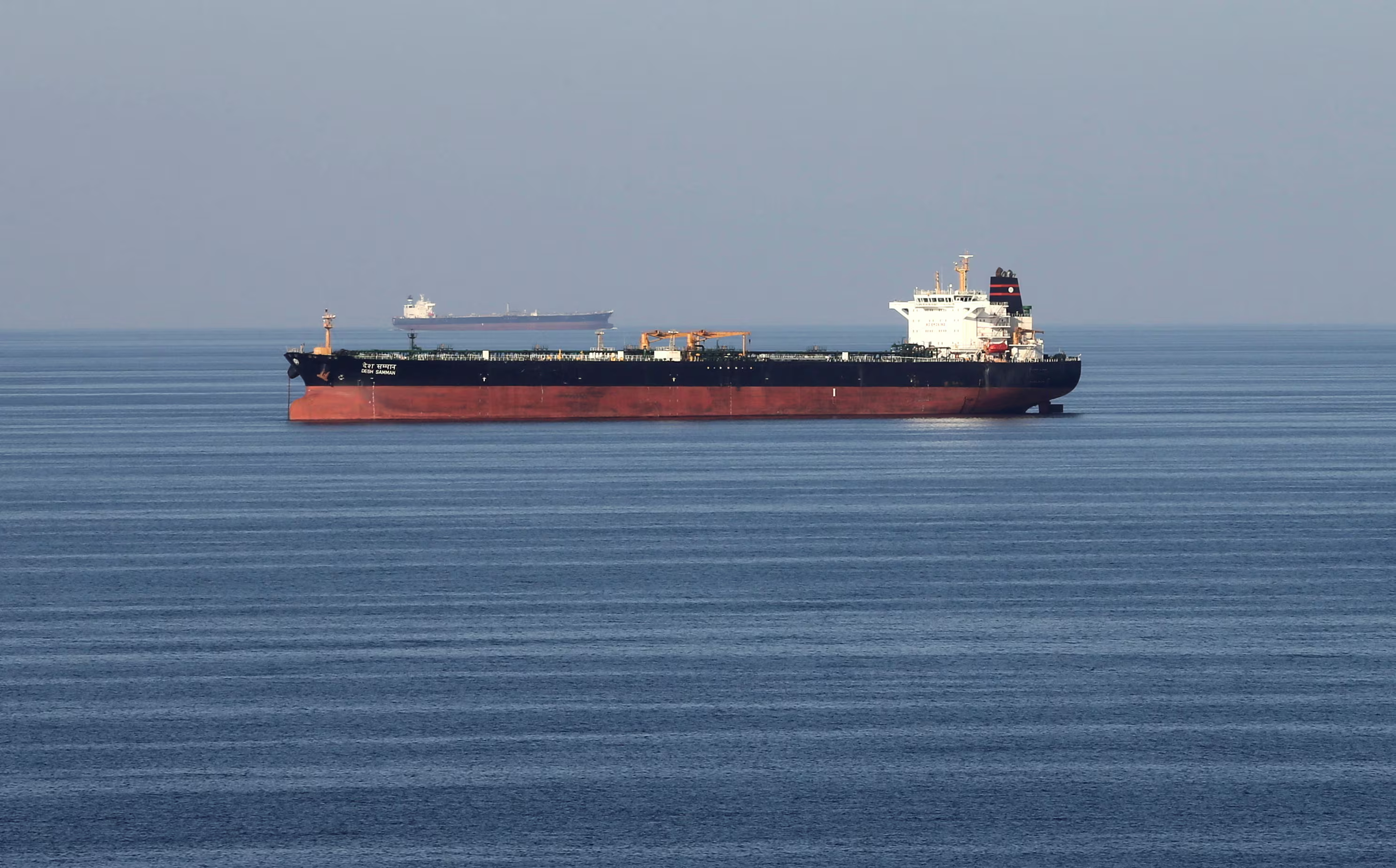
The scale of the price movement reflects the severity of the supply threat. According to data from energy consulting firm Kpler, tanker traffic through the Strait of Hormuz has effectively come to a halt, with shipping companies taking precautionary measures. More than 14 million barrels per day of crude oil passed through the waterway on average in 2025, accounting for roughly one-third of the world's total seaborne crude exports.
Iran has announced it is closing the Strait of Hormuz following the strikes, a move that would choke off one-fifth of global oil supply. Attacks on at least two vessels travelling through the narrow waterway have compounded the disruption. Barclays analysts warned in a note to clients that Brent could reach $100 per barrel as the security situation in the Middle East spirals further.
Tanker Insurance and Freight Rates Compound the Shock
Even without a physical blockade, insurance rates for tankers moving crude and petroleum products through the Gulf have surged. Freight rates on Middle East-to-Asia routes have tripled this year, according to industry reports, signalling elevated risk premiums across global supply chains. Bob McNally, president of Rapidan Energy Group, described the situation as an "all skate" across energy benchmarks, with refined product margins, Dutch TTF gas prices and other benchmarks all rising in tandem.
Kpler analysts expect Brent to open Monday in the $85-$90 range, with some scenarios placing intraday highs above $88. The consensus is that this conflict presents a more severe supply picture than the brief Israel-Iran war of June 2025, primarily because physical supply is now genuinely at risk.
Food Inflation Threat: From Diesel Pumps to Dinner Tables
The surge in crude oil prices carries consequences well beyond energy markets. Higher oil translates directly into elevated costs across the food supply chain, from farm-level diesel consumption and fertilizer production to transportation and processing.
Agricultural commodity markets, including soybeans, corn and wheat, are vulnerable to heightened volatility when energy shocks coincide with currency swings, particularly when maritime trade routes toward Asia are threatened. Analysts at Agrolatam estimate that if oil reaches $100 per barrel, global inflation could rise by as much as 0.7 percentage points, tightening financial conditions and increasing farm financing costs.
Fertilizer Costs Under Direct Pressure
Nitrogen fertilizers, which depend heavily on natural gas as a feedstock, are among the most exposed agricultural inputs. Urea and other petroleum-derived fertilizers were already trading at elevated levels following the prolonged impact of the Russia-Ukraine war on energy markets. A sustained increase in crude oil and natural gas prices would amplify production costs for fertilizer manufacturers and pass those increases through to farmers globally.
Agricultural input costs are therefore set to rise across multiple channels simultaneously: diesel for farm machinery and irrigation pumps, fertilizers for crop nutrition and elevated freight charges for moving both inputs and outputs.
Global Commodity Markets Brace for Cascading Price Pressure
Wheat and Rice Vulnerable to Oil-Price Correlation
Wheat prices have historically moved in correlation with crude oil. One of the factors that kept global wheat prices relatively flat over the past two years was the stability of crude oil near $60-$67 a barrel. With that anchor now dislodged, traders expect upward price pressure on wheat futures as energy cost pass-through intensifies.
Rice, a water-intensive crop that relies heavily on diesel-powered irrigation in major producing regions across South and Southeast Asia, faces similar exposure. The FAO's most recent report on Iran noted that wheat prices in Tehran had already risen 50% and rice prices had tripled compared with the previous year, even before the February 28 strikes began.
Vegetable Oils and Biofuel Feedstocks
Vegetable oil markets face a dual threat. Higher crude oil prices increase demand for biodiesel blending, drawing greater volumes of canola, palm oil, soybean oil and coconut oil into the fuel supply chain. This competition between food and fuel uses tightens edible oil supplies and pushes prices higher.
Should Brent sustain levels above $90 or approach the $100 threshold, global commodity markets would likely see significant demand shifts toward biofuel feedstocks. Corn and sugarcane used in ethanol production would similarly face upward price pressure, as higher gasoline prices make biofuel blending more economically attractive.
Synthetic Rubber and Downstream Effects
The petroleum-derived raw materials used in synthetic rubber production are also exposed. Rising crude oil prices would increase synthetic rubber costs, which in turn tends to lift natural rubber prices as buyers seek substitutes. This ripple effect illustrates how energy shocks propagate through seemingly unrelated commodity markets.
Strait of Hormuz: The World's Most Critical Oil Chokepoint
The strategic importance of the Strait of Hormuz cannot be overstated. Roughly 15 million barrels of crude oil per day, approximately 20% of the world's total oil supply, transit this narrow waterway connecting the Persian Gulf to the Gulf of Oman. Major exporters including Saudi Arabia, Iraq, the UAE, Kuwait and Iran depend on the route for their oil shipments.
Iran's threat to close the strait represents the most severe potential supply disruption in decades. The Kpler analysis noted that three-quarters of the crude passing through the Strait of Hormuz is destined for China, India, Japan and South Korea. China alone imports roughly 1.6 million barrels per day from Iran, and any prolonged disruption would force Beijing to bid for substitute supplies from other producers, further tightening global markets.
OPEC+ responded on March 1 by announcing an increase in production of 206,000 barrels per day for April, more than analysts had anticipated. However, a critical constraint remains: a significant portion of Gulf spare capacity cannot reach global markets if the Strait of Hormuz remains inaccessible. Saudi Arabia's East-West Pipeline and the UAE's Fujairah pipeline offer partial alternatives, but terminal infrastructure limits throughput.
Food Security Concerns for Developing Nations
The rise in crude oil prices signals mounting food security risks for vulnerable populations across Asia and Africa. Poor and import-dependent nations face a compounding crisis: higher energy costs drive up food prices precisely when transportation networks and trade routes are disrupted.
Iran itself, with a population exceeding 93 million, was already grappling with severe food inflation before the strikes began. The country's inflation had surpassed 46% in January 2026, with food prices nearly doubling over the previous year. The conflict will further disrupt Iran's ability to import food commodities, tightening domestic supply at a time when agricultural infrastructure and transportation networks face direct damage.
Across the broader developing world, nations that rely on imported wheat, rice and cooking oils face the prospect of sharply higher costs. India, which holds significant foodgrain reserves, may be positioned to play a stabilising role in regional food markets. However, the broader trajectory depends on the duration of the conflict and the extent to which crude oil prices remain elevated.
Conclusion: Volatility Set to Persist Across Commodity Complex
Global commodity markets are entering a period of sustained volatility, with crude oil prices at the centre of a cascading risk across energy, agriculture and logistics. The duration of the US-Iran conflict, which President Trump indicated could span up to four weeks, will determine whether the current price shock becomes a prolonged structural shift.
For agricultural markets, the transmission channels are clear: diesel costs, fertilizer prices, freight rates and biodiesel demand all move higher when crude oil rises. Wheat, rice, corn, vegetable oils and sugar face broad-based upward pressure. Precious metals, led by gold which has gained over 22% in 2026, are also attracting safe-haven flows.
The commodity complex now awaits clarity on two critical variables: whether the Strait of Hormuz will see a sustained closure or gradual reopening, and whether OPEC+ spare capacity can meaningfully offset lost Iranian barrels. Until those questions are resolved, food inflation risks and global commodity markets will remain under pressure.